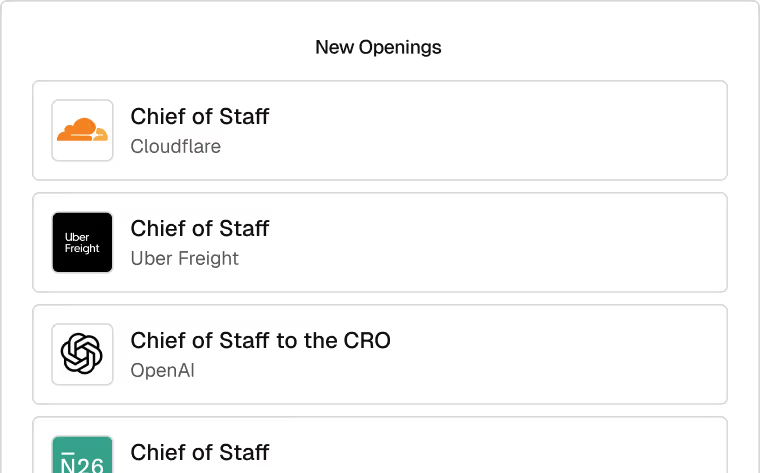
If you’ve ever scanned leadership job listings, you’ve probably seen the title Chief of Staff and paused to wonder what the role actually looks like day to day.
The answer isn’t a neat checklist. While responsibilities vary widely by company, the purpose of the role is fairly consistent. A Chief of Staff works as a close partner to a senior leader, helping turn priorities into real progress and making sure the organization functions well at the top. The role sits somewhere between strategy, execution, and communication — and deliberately avoids routine administrative work.
Instead of managing tasks, a Chief of Staff helps leaders use their time, attention, and decisions more effectively.
Core Responsibilities of a Chief of Staff
Because the role is built around the needs of a specific leader, no two Chief of Staff positions look exactly alike. That said, most roles tend to cluster around a few common areas.
1. Turning Strategy Into Execution
One of the most important parts of the job is making sure strategy doesn’t stop at the planning stage. When leadership sets priorities, the Chief of Staff helps turn them into something teams can actually act on. This often means:
- Taking a broad goal and break it into a small number of concrete initiatives people can actually work on
- Pushing teams to agree on timelines and intermediate checkpoints instead of vague targets
- Stepping in when ownership is fuzzy and help clarify who is responsible for what
- Tracking how work is progressing and flag issues before they become visible to leadership
- Noticing when everyday execution starts drifting away from what leaders said mattered
- Helping the executive keep attention on the few priorities that really move the business
2. Managing Cross-Functional and “Unowned” Work
Most organizations have projects that everyone agrees are important, but no one quite owns. They sit between teams, move slowly, and tend to resurface only when something goes wrong. Chiefs of Staff often pick up this kind of work. That can look like:
- Stepping in as the default owner when an initiative cuts across several teams
- Pulling together stakeholders who don’t normally work closely with each other
- Turning loosely defined ideas into something with a clear scope and end goal
- Keeping projects moving when priorities shift or attention drops
- Providing leadership with a single point of accountability and updates
- Translating big-picture intent into practical next steps
This work rarely fits neatly into a job description, but without it, a lot of important progress never happens.
3. Improving Communication at the Leadership Level
At the top of an organization, the problem is rarely lack of information. It’s the opposite. Leaders are flooded with updates, context, and competing narratives. A Chief of Staff helps sort through that by:
- Deciding what actually needs executive attention and what doesn’t
- Condensing complex issues into short, usable briefs
- Drafting or shaping internal messages so decisions land clearly
- Making sure different leaders aren’t sending conflicting signals
- Identifying patterns where communication keeps breaking down
- Fixing gaps between what leadership thinks was communicated and what teams heard
Effective communication here usually means saying less, not more.
4. Making Meetings and Decisions More Effective
A significant amount of a Chief of Staff’s influence shows up in how leadership meetings run. Instead of letting time get eaten by status updates, they often focus on basics:
- Shaping agendas around decisions that actually need to be made
- Making sure the right voices are present — and unnecessary ones aren’t
- Circulating materials ahead of time so meetings aren’t spent catching up
- Clarifying who owns a decision and what happens next
- Following up afterward to make sure actions don’t stall
- Challenging meetings that exist out of habit rather than necessity
What matters most happens after the meeting. A Chief of Staff makes sure decisions survive beyond the calendar invite.
How the Role Changes With Company Size
What a Chief of Staff does in practice depends heavily on where the company is in its lifecycle.
- In an early-stage startup, the Chief of Staff is usually deep in the weeds. One day it might be helping a founder prepare for investor conversations, the next it’s untangling an operational issue or chasing alignment across a small but fast-moving team. The role often feels like being a general-purpose extension of the founder, stepping in wherever things are breaking or moving too slowly.
- As companies grow, the work starts to settle into clearer patterns. In a mid-sized organization, a Chief of Staff is more likely to focus on coordination and structure — improving how teams work together, putting basic processes in place, and preventing misalignment as headcount increases.
- In large organizations, the role shifts again. The Chief of Staff is less hands-on with day-to-day execution and more involved in navigating complexity at the leadership level. That can mean managing sensitive stakeholder relationships, representing the executive in certain forums, or helping steer decisions through layers of the organization.
The day-to-day work changes, but the point doesn’t. At every stage, the Chief of Staff exists to make it easier for leadership to lead well.
Why the Chief of Staff Role Matters
As organizations grow, leaders inevitably become a bottleneck. Decisions stack up, priorities compete, and execution slows. A Chief of Staff helps relieve that pressure by acting as an extension of the executive.
With a deep understanding of the leader’s goals — and the trust to move work forward — the Chief of Staff enables faster decisions, clearer alignment, and stronger follow-through. In many organizations today, the role isn’t a luxury. It’s a practical response to complexity.
Final Thoughts
So what does a Chief of Staff actually do? At a basic level, the role is about leverage. A good Chief of Staff helps leaders spend their time on the few things that really matter, while keeping the rest of the organization pointed in the same direction.
They sit between strategy and execution, help untangle complex initiatives, and make communication at the top work better than it otherwise would. When the role is done well, it doesn’t draw much attention to itself. You mostly notice it in the absence of chaos: decisions stick, priorities are clearer, and the organization moves with less friction.

Sina is a startup operator and entrepreneur with a background in startups & VC. Before founding the bootstrapped venture studio Wizard Ventures, he worked as Chief of Staff at unicorn SellerX / KW-Commerce. After seeing firsthand how life-changing the Chief of Staff role can be, he built this project to help exceptional talent find the right opportunities in top tech ecosystems.